
 Data centers are built around one critical reality: when equipment generates so much heat that it must go somewhere, that somewhere cannot be any space that affects equipment performance or uptime.
Increased rack densities and AI-ready systems are pushing the limits of today’s data centers, and managing airflow is critical to performance. Implementing aisle containment systems in a data center is a proven solution for controlling airflow and achieving operational goals.
What is data center aisle containment?
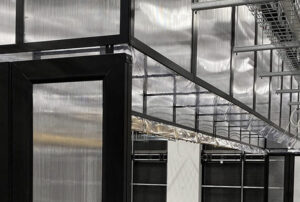
A data center aisle is the space between rows of server racks. Data center aisle containment uses physical barriers to keep hot exhaust air and cold supply air from mixing between rows of server racks. In a typical data center, racks are arranged in alternating hot and cold aisles. Cold air is delivered to the front of the racks, where servers pull it in to stay cool, and the hot air exits from the back of the racks into a separate aisle.
For new construction data centers, containment can be included from the start, and for retrofits, it can improve airflow management without needing a full redesign.
What is the difference between hot and cold aisle containment?
Hot aisle and cold aisle containment both help manage airflow, but they do it in different ways. Both are designed to separate hot and cold air, but they control different parts of the data hall and can support different cooling strategies depending on the facility’s layout.
Hot Aisle Containment
Hot aisle containment surrounds the aisle where hot air leaves the racks. It captures this warm air and sends it to the cooling system, stopping it from mixing with cold air in the data hall.
Cold Aisle Containment
In comparison, cold aisle containment caps the cold aisle to stop cold air from escaping before the equipment can use it. That means better airflow, less wasted cooling, and a more consistent environment for IT equipment.
While both options help manage airflow, the best option for your data center depends on your facility’s design, cooling plan, rack setup, density needs, and goals.
How do I choose between hot or cold aisle containment?
The right containment strategy for your data center depends on its design, cooling delivery, and the density the space needs to support.
Cold aisle containment is often used when the cooling layout, rack density, or retrofit conditions make it more practical to keep cold supply air within the aisle in front of the racks. It can be a good fit for existing data centers where the cold aisle is easier to enclose, especially when the facility uses raised-floor cooling or has overhead constraints that make hot aisle containment more difficult.
Hot aisle containment focuses on the heat behind the racks. The idea is to keep that hot exhaust from drifting back into the room and mixing with cooler supply air. When the hot air is separated and routed back to cooling, airflow is easier to manage and the cooling system can work more efficiently. That becomes especially important as racks get denser and heat loads increase.
Final takeaways
The main goal of any hot or cold aisle containment system is to better control airflow. When you pick the right containment system for your data center, it helps ensure your cooling systems work more efficiently, supporting overall performance. For data centers adding more high-density equipment, especially around AI workloads, airflow control matters now more than ever. It helps improve cooling performance, reduce wasted energy, and give teams more flexibility as demand grows.
Polargy’s approach to aisle containment
At Polargy, aisle containment isn’t treated as a standalone barrier system; it’s part of how we help teams build a more coordinated white space.
We design, build, and integrate containment solutions that support airflow management, simplify field coordination, and provide data center teams with a more scalable path from design through installation.
Ready to talk about your next build? Contact our team: https://polargy.com/contact-us/